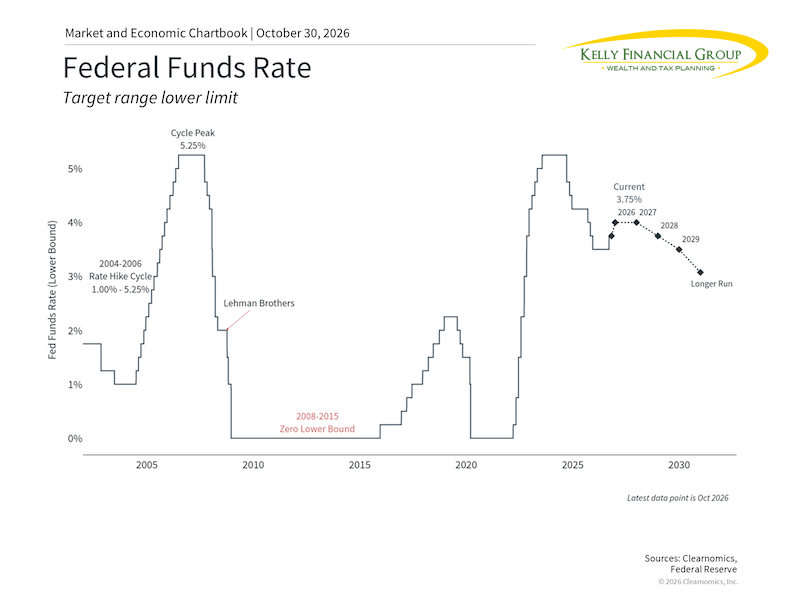
The Fed's decisions on interest rates are one of the most closely watched factors in financial markets, affecting everything from borrowing costs to economic growth and investment returns.
Here are some key points to consider:
• Fed officials voted 10-2 to keep the federal funds rate at 3.75% to 4%, after raising rates in September for the first time in three years. The FOMC statement noted that "inflation remains elevated," "economic activity is expanding at a strong pace," and "job gains have kept pace with the workforce."
• Two members dissented and would have preferred to raise rates again, reflecting internal debate about whether current policy is doing enough to control prices.
• This decision has been referred to as a "hawkish hold" since inflation remains higher than economists would like and the Fed is expected to raise rates again. Futures markets are pricing in additional rate hikes in December and possibly again next year. So, while the Fed decided to keep rates steady for now, it isn't expected to stay on hold if inflation remains at these levels.
• Interest rates remain high with the 10-year Treasury yield still around 5%, and the 30-year around 5.3%. Real yields, which strip out inflation, are also at multi-year highs, meaning borrowing costs are also elevated due to healthy economic growth.
• At his press conference, Fed Chair Kevin Warsh announced a change to the FOMC schedule. Rather than devote each Fed meeting (eight per year) to voting on the federal funds rate, one meeting in 2027 will focus exclusively on broad monetary policy strategy with no vote on the federal funds rate nor a policy statement. He expects in 2028 there will be two of these meetings (and six for setting policy). The stated goal is to discuss overall strategy, not just vote on the federal funds rate at each meeting.
While uncertainty around Fed policy can create market volatility, staying focused on long-term financial goals and maintaining a diversified portfolio have historically been the most reliable ways to navigate these short-term periods.