


With the summer coming to an end and kids back in school, I wanted to share some perspectives on where financial markets stand and what’s currently driving portfolios.
In recent months, the stock market has climbed to new record levels while, at the same time, interest rates are near their highest levels in two decades. This is positive for investors and their financial plans. It also raises questions since high interest rates are often viewed as slowing the economy and the stock market. What’s driving both sides of these factors today?
What is driving the stock market higher?
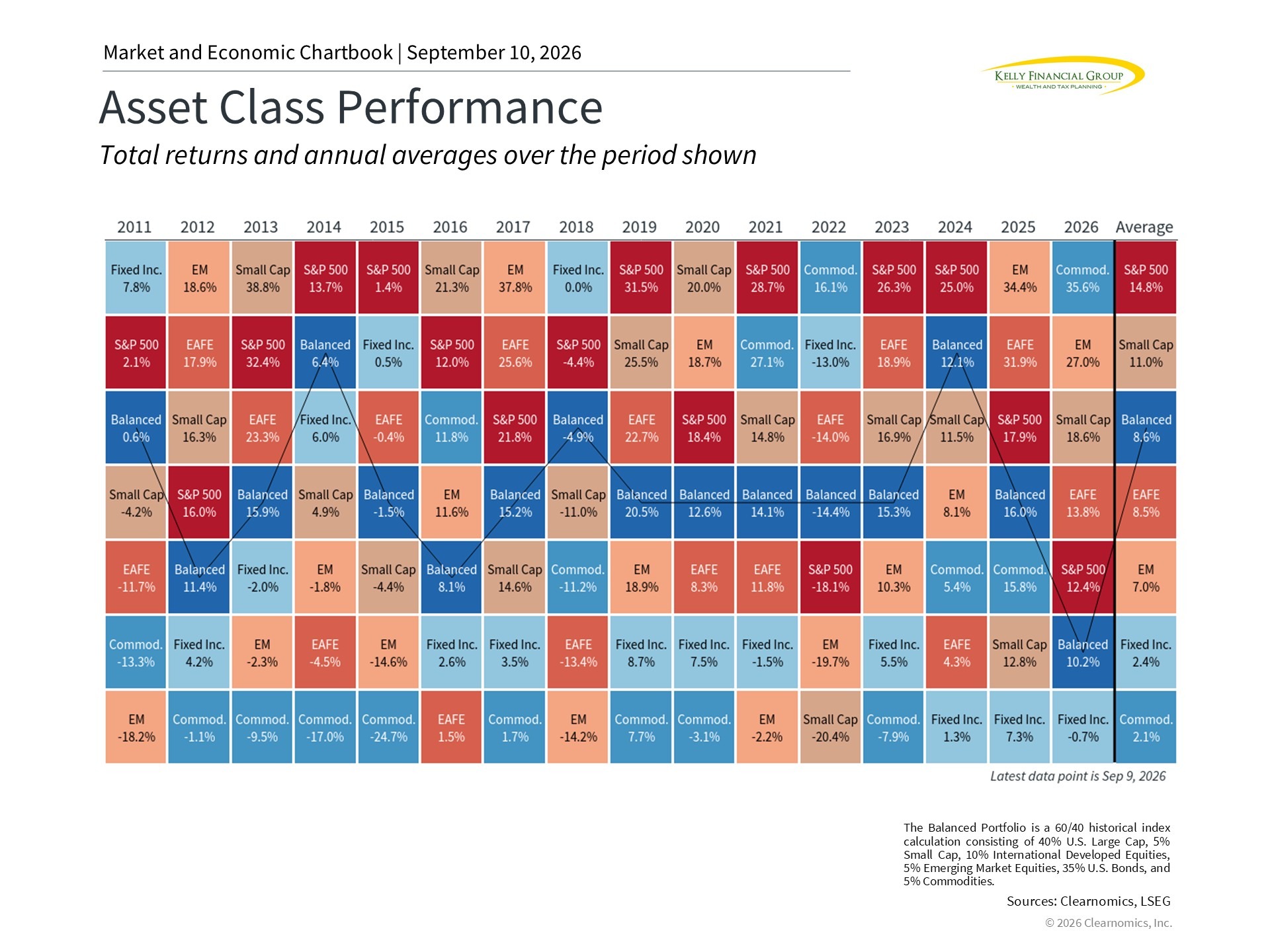
Major stock market indices have posted strong double-digit returns so far this year, with broad participation across many sectors. Energy stocks have benefited from higher oil prices, technology companies continue to attract investor enthusiasm around artificial intelligence, and industrial companies have performed well as the domestic economy remains resilient. This breadth of performance is an encouraging sign, since it is supported by many parts of the market.
Perhaps the most important driver of the stock market rally this year is corporate earnings. In the long run, the stock market tends to follow the path of corporate profits. Current forecasts suggest that earnings for the S&P 500 are expected to grow at over 30% this year, which would be well above the historical average of around 8%.1 When companies are generating strong profits, stock prices tend to reflect that strength over time.
Higher interest rates are an important development as well, since rates can rise for different reasons. Rates that rise because of inflation concerns can weigh on both stocks and bonds, which is what happened after the pandemic.
But rates can also rise because the economy is growing, which pushes up what are known as “real yields,” meaning bond yields after accounting for inflation. Rising real yields tend to reflect confidence in economic growth rather than fears of inflation. That is largely what has been happening this year, which helps explain why stocks have continued to climb even as rates remain elevated.
What do higher interest rates mean for bonds?
Bond prices and bond yields move in opposite directions, so rising rates have kept bond returns relatively muted this year. This can potentially raise questions for those watching their stock holdings reach new highs while bond holdings sit largely flat, but when it comes to portfolios, this is by design. A well-constructed portfolio naturally has asset classes that move in different directions, at different times.
There is also an important silver lining here. Higher yields mean that bonds are now offering more income than they have in many years. Investment-grade corporate bonds and Treasury securities are currently paying income levels that were simply not available during the long stretch following the 2008 financial crisis, when interest rates were held near zero for many years. For investors who rely on their portfolios for income, or who want to balance the risk of stocks with more stable assets, this is an important development.
Specifically, the 10-year Treasury yield recently reached approximately 4.9%, a level not seen since late 2023, and the 30-year yield has moved above 5.3%, a level last seen around 2006.2 While higher rates do make borrowing more expensive across the economy, they create opportunities for long-term investors as well.
Investing for the long term
Stocks and bonds serve different purposes in a portfolio, and both are doing their jobs in the current environment. Stocks are benefiting from strong corporate earnings and steady economic growth. Bonds are providing more income than they have in years, which helps balance the risk that equities carry. Together, they support the kind of portfolio balance that allows investors to stay focused on their long-term goals rather than reacting to every shift in the market.
It’s natural for the stock market to hover near all-time highs during bull market cycles. This is not to say that volatility cannot occur. Periods of uncertainty are a normal part of investing, and they can arise from many sources, including changes in Fed policy, geopolitical events, or shifts in economic data. What history consistently shows is that long-term investors who stay the course, and maintain balance across asset classes tend to fare better than those who move in and out of markets trying to anticipate each turn.
As always, please do not hesitate to reach out if you have questions about what the current environment means for your specific situation. I am always happy to walk through how your financial plan is positioned to navigate these conditions.
-
References
1. Clearnomics research using Standard & Poor's and LSEG data, as of September 9, 2026
2. Clearnomics research and Bloomberg data, as of September 9, 2026
Index Descriptions
S&P 500
The Standard & Poor's 500 Index is a capitalization-weighted index of 500 stocks designed to measure performance of the broad domestic economy through changes in the aggregate market value of 500 stocks representing all major industries.