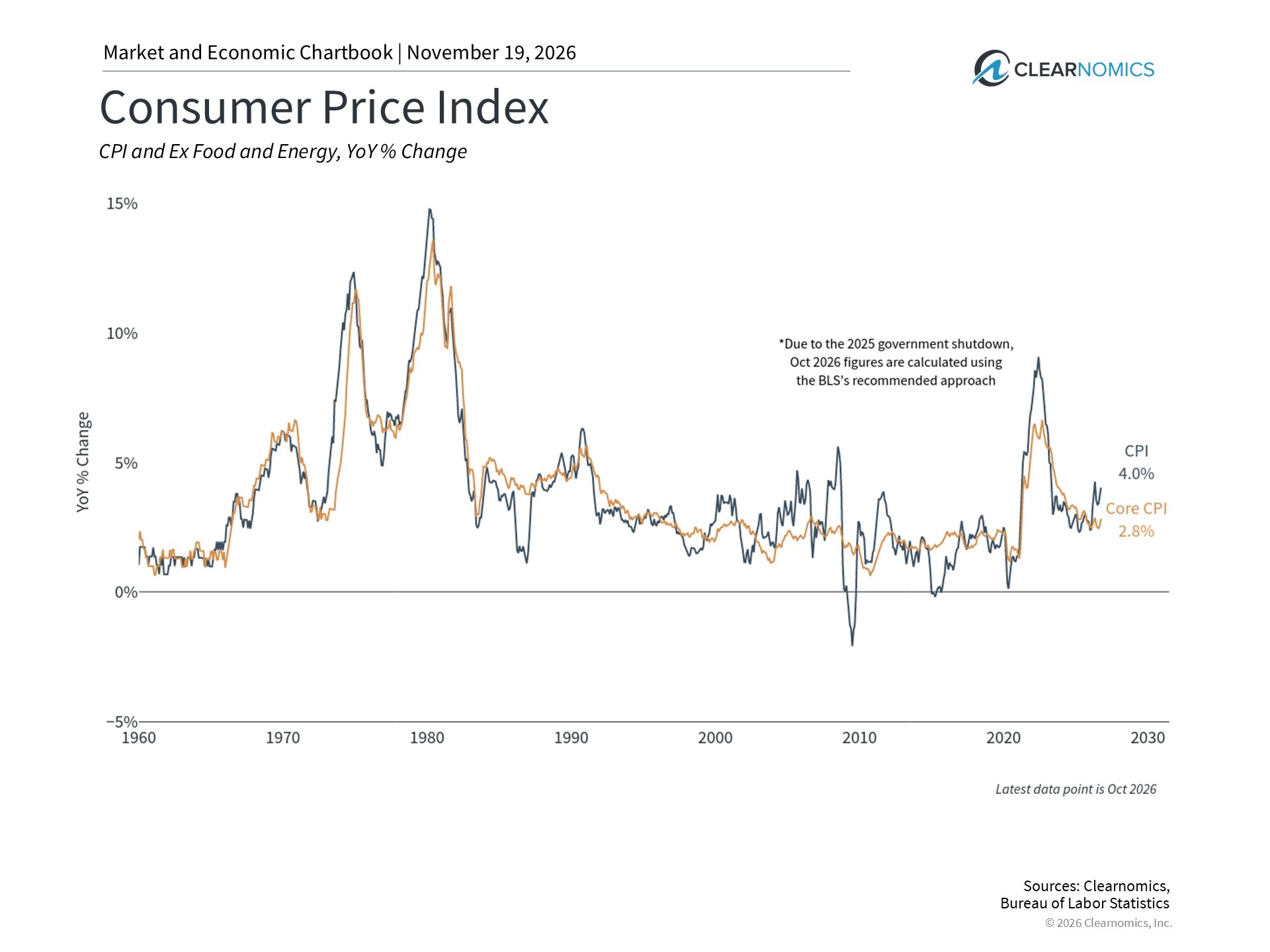
CPI measures how prices change over time for everyday goods and services, so it can tell us what consumers are experiencing. This also has implications for the Federal Reserve as they attempt to balance inflation and jobs.
Here are some key points to consider:
• Headline CPI rose 0.4% in October on a monthly basis, exceeding expectations of 0.3%. The Bureau of Labor Statistics did not publish a year-over-year figure since October 2025 figures are not available due to last year's government shutdown. However, using their recommended approach to approximate this data, CPI rose 4.0% on a year-over-year basis, the highest since May, and 2023 before that.
• Shelter, food, and energy were the biggest contributors to overall CPI, with energy up 0.7% for the month. Core CPI, which excludes food and energy, rose 0.3%, which was also higher than consensus forecasts. On a year-over-year basis, core CPI rose 2.8%, based on the same calculation.
• That said, the increase in energy prices was much slower than the previous month's 5.2%. There may also be some relief ahead since oil prices have dropped following the midterm elections. These lower energy costs, if they persist, should show up in the November CPI report, potentially easing headline inflation.
• This is a challenging environment for the Fed. Following the CPI report, markets raised expectations that the FOMC will raise rates again in December. However, because oil prices have already declined, many of these numbers could reverse in the coming months. So, while the Fed has communicated that it is taking inflation seriously, it also does not want to react to a one-month data point.
While near-term inflation pressures are real, keeping a long-term perspective is key, as economic cycles have historically worked through periods of elevated inflation and adjusted over time.